
(b. Milan 1914; d. South Shields, Tyneside 1990)
Those that knew Baron Avro Manhattan claim him to be one of the most remarkable men of the twentieth century. In 2014, however, on the eve of a major auction of newly discovered work, The Telegraph wrote an article that drew attention to the somewhat humble circumstances of his death in a modest terraced house on Tyneside.[1]Perry, Keith, ‘Baron and friend of Picasso spent years living in modest South Shields terraced house’, The Telegraph, 23 September 2014 For Manhattan was a glamorous Italian born aristocrat; an artist, poet and writer of over 60 political tomes, who counted Tolstoy, Pablo Picasso, HG Wells and George Bernard Shaw among his circle of friends. [2]‘The Baron and Picasso’s friend’ The Shields Gazette, Tuesday, 11th October 2016 How was it that this compelling and brilliant man, who lived such an extraordinary life, had disappeared so quietly from view at the end of his life?
Born Teofilo Lucifero Gardini, of Dutch, Swiss, Italian, Brazilian and American ancestry, Avro Manhattan, as he later became known, began his career as a writer and artist in his native Italy. First-hand accounts report he spent summers in Suna, Verbania, in the home of Paolo Troubetzkoy, an artist and a sculptor described by George Bernard Shaw as “the most astonishing sculptor of modern times”[3]G.B. Shaw, Preface to the catalogue of an exhibition of sculpture by Troubetzkoy at the P. & D. Colnaghi Galleries, London, 1931, in The Complete Prefaces: 1930-1950 (Allen Lane, 1997), pp. 97-98.. A close family friend in Italy remembered Manhattan at that time as a ‘radiant young man, attractive, head-to-toe from the sun, always in a good mood’; a man who, when he set up his easel on the shores of Lake Maggiore, drew crowds of adults and children who watched him paint, his younger fans calling him their ‘Marsucci’ for his ‘firework imagination’ and ability to entertain them with stories.[4]Memories of Gunda Kraepelin recorded in The Shield Gazette, Memories of man with ‘firework imagination’ 27th December 2016

In the 1930s Manhattan studied in Paris; it was where he met and befriended Picasso, visiting his studio. He immersed himself in the political and artistic society of that time and worked constantly. He painted hard and turned his ‘firework imagination’ to the invention of epic poems – mythic-dystopias with political subtexts – which he illustrated with a remarkable series of graphite and watercolour vignettes.

Cigni Cassiopeia
Signed by the Artist and dated 1936, a drawing by Avro Manhattan to illustrate his epic poem ‘Hail to Us, The Priests of Astro Science’.
Manhattan’s illustrations seem to draw influence from the bold geometric forms of Cubism as well as the Constructivist and Futurist movements. The skyscrapers of Manhattan’s dystopian setting here in ‘Cigni Cassiopeia’ call to mind the drawings of Erich Kettelhut for Fritz Laing’s ‘Metropolis’.
So, Manhattan’s career as a painter began well. Back at home, in Italy, he exhibited works at a number of local museums and two of his oil paintings are in the possession of The Museo del Paesaggio, in Verbania-Pallanza, where Gardini, as he was then, also arranged several exhibitions of his paintings including, for the last time, shortly before he left his homeland for good.
However, in World War II Manhattan was imprisoned for refusing to serve in Mussolini’s Fascist army. Ever industrious, in prison he wrote his first book on astronomy (Manhattan was a keen amateur astronomer and a life member of the British Interplanetary Society). When freed, he fled to England, changing his residence to London (It was not until 1953 that he legally changed his name to Manhattan, relinquishing the names “Teofilo Angelo Mario Gardini” and “Teophile Lucifer Gardini”). It didn’t take him long to settle, and he wasted no time in beginning work: he wrote several political commentaries for the BBC and operated a Radio Freedom station, broadcasting to occupied Europe.
Although never a member of any political party, church or religion, Manhattan’s life and work never strayed far from polemic.
A graduate of both The Sorbonne, Paris and The London School of Economics, he was an intellectual committed to a life of thought as well as a person of conscience who lived life according to moral principles.
It is unsurprising that he was made a Knight of Malta out of recognition for his endeavours in the 1940s.

Manhattan embraced his new London life in all its dimensions. Reportedly, women adored him; he was by all accounts charismatic, very charming and devilishly handsome. Photographer Ida Kar’s portrait of him in the National Portrait Gallery bears testament to his looks and captures a certain cool confidence and even a coquettishness about his manner too. Manhattan must have been pleased to be photographed by Kar, who in 1960 was the first photographer to be given a major retrospective of her work at a major London gallery at The Whitechapel: her subjects were the most celebrated figures from the literary and artistic spheres of the time including Henry Moore, George Braque, Gino Severini and Jean-Paul Sartre.
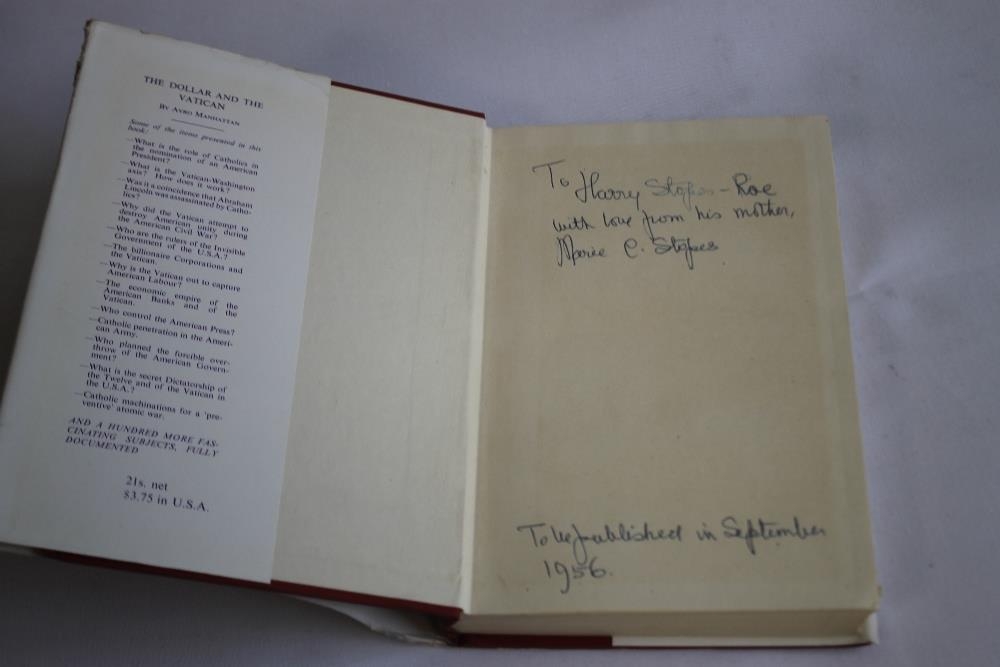
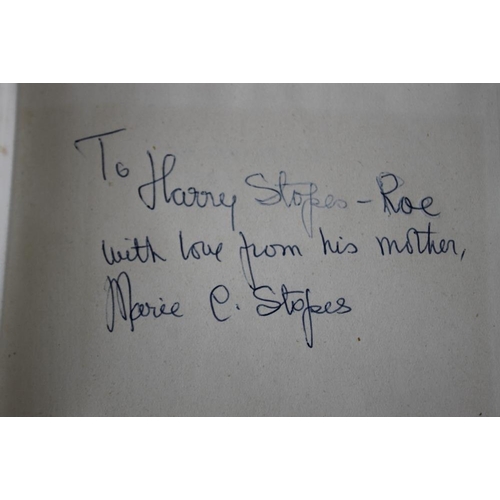
However, if Manhattan enjoyed London’s social scene it didn’t distract him from his work. By 1950 he was better known as a writer than painter. He had also truly made his name with his book ‘The Vatican in World Politics’, which ran to fifty editions and was translated into most major languages including Chinese, Russian and Korean becoming a world best-seller. And by the close of that decade, Manhattan’s reputation as a well-respected author was secure. He had a wide and influential circle of friends. Steadfast acquaintances throughout this time included the likes of Lord Alexander of Hillsborough, leader of the House of Lords, who collected all Manhattan’s writing. Other loyal friends included Dr Marie Stopes, scientist and pioneer of birth control. Indeed, it is suggested Stopes rejected her husband Humphrey and formed a relationship with Manhattan in the last years of her life, despite him being much junior to her in years.[5]Debenham C. (2018) Epilogue. In: Marie Stopes’ Sexual Revolution and the Birth Control Movement. Palgrave Pivot, Cham. https://doi.org/10.1007/978-3-319-71664-0_10 She was a natural ally, in any case, in view of his stance against the Catholic Church, and Stopes appointed Manhattan a member of her Stopes Birth Control Clinic committee before she died in 1958.
Image: An advance publication copy of ‘The Dollar and the Vatican‘ inscribed by Marie Stopes to her son Harry.

In 1961 Manhattan met his wife-to-be, a nurse, Anne Cunningham Brown and two years later, they moved into a house belonging to her mother on Henry Nelson Street in South Shields, North East England, where Manhattan would spend much of his later life. According to filmmaker Gary Alikivi who has conducted research into Manhattan’s life[6]https://garyalikivi.com/2019/07/13/secrets-and-lies , the couple enjoyed travelling, especially in the States, and they also spent time in their flat in Kensington and an apartment they owned in Sitges, Spain. But they spent the majority of their life together in South Shields, where perhaps Manhattan enjoyed some respite from London and writing with its deadlines, fast-pace and pressure. By all accounts, Anne and Avro were a happy couple; if they are anything to go by, Manhattan’s paintings from this period are certainly full of colour, flare and humour and if they evoke a state of mind it is one of spirit, energy and wit.

Manhattan’s figure studies of the late ’50s and early ’60s have a confident clarity of line and expression that appears almost effortless.


Fundamentally ceaseless, and some might say restless in his pursuits, Manhattan continued to paint and write until his death at the age of 76. In view of his success and the body of work he left behind, it can only be conjectured why Baron Avro Manhattan is not better remembered. He seemed to be impossibly talented. His political writing and his painting have been touched on here but he was also an astronomer who wrote poetry in English Latin, Spanish and French. He wrote fiction, mostly science-fiction and dystopias, publishing over 60 books in his career.
So why isn’t this creative genius better remembered in the popular imagination? We do know that he was un-boastful of his accomplishments, ‘a modest man who was always more interested in what was happening in your life than about talking about his past.”[7]The Shields Gazette Dead baron was pal of Picasso and HG Wells Jan 24, 2008 So perhaps this aristocratic gentleman, not built for self-promotion, was destined to be eclipsed by his famous friends, whose company and influence had been so important throughout his life. (It cannot help that, having had no children, Manhattan left no family after his death to preserve and promote his work and his story). However, maybe the truth is very simply that, a rare and true polymath whose life was spent juggling so many fields of expertise, his lack of lasting acclaim is a result of society’s disinclination to reward with formal acclaim supposed ‘Jack of all trades’ who refuse to specialise in just one.
References
| ↑1 | Perry, Keith, ‘Baron and friend of Picasso spent years living in modest South Shields terraced house’, The Telegraph, 23 September 2014 |
|---|---|
| ↑2 | ‘The Baron and Picasso’s friend’ The Shields Gazette, Tuesday, 11th October 2016 |
| ↑3 | G.B. Shaw, Preface to the catalogue of an exhibition of sculpture by Troubetzkoy at the P. & D. Colnaghi Galleries, London, 1931, in The Complete Prefaces: 1930-1950 (Allen Lane, 1997), pp. 97-98. |
| ↑4 | Memories of Gunda Kraepelin recorded in The Shield Gazette, Memories of man with ‘firework imagination’ 27th December 2016 |
| ↑5 | Debenham C. (2018) Epilogue. In: Marie Stopes’ Sexual Revolution and the Birth Control Movement. Palgrave Pivot, Cham. https://doi.org/10.1007/978-3-319-71664-0_10 |
| ↑6 | https://garyalikivi.com/2019/07/13/secrets-and-lies |
| ↑7 | The Shields Gazette Dead baron was pal of Picasso and HG Wells Jan 24, 2008 |